
In today's fiercely competitive e-commerce landscape, capturing and maintaining customer attention has become a daunting challenge. Did you know that nearly 70% of online businesses find it difficult to convert casual browsers into actual buyers? This is where AI sales assistants come into play, offering a transformative solution to boost online revenue. By leveraging AI-driven customer engagement, these digital sales assistants are changing the way retailers interact with potential buyers, paving the way for increased online sales.
The rise of AI sales software has introduced personalized sales assistants that tailor interactions to individual customer needs and preferences. This smart sales solution not only enhances the shopping experience but also significantly contributes to sales conversion optimization. Retailers can now utilize these automated sales tools to provide real-time support, recommend products, and address customer queries efficiently. Through this approach, e-commerce revenue growth becomes more attainable as businesses can engage customers at every step of their shopping journey.
Relio is an AI-powered chat widget for e-commerce stores that recommends products and captures leads through natural conversation. It exemplifies how the right AI sales tool can transform a digital storefront. With features like 'Product Recommendation Engine' and 'Lead Capture Automation,' Relio ensures that your online store is not just another option but the preferred choice for customers. As businesses seek innovative ways to increase revenue, embracing AI-driven sales strategies might just be the competitive edge they need.
Understanding the Challenges of Boosting Online Revenue
Increasing online sales is a priority for e-commerce stores, yet many face hurdles that impede growth. One such challenge is high cart abandonment rates. Studies show that nearly 70% of online shopping carts are abandoned before purchase. This results in significant revenue loss for businesses of all sizes. Additionally, low conversion rates further compound the problem. The average e-commerce conversion rate hovers around 2.5%, indicating a large gap between site visitors and actual buyers.
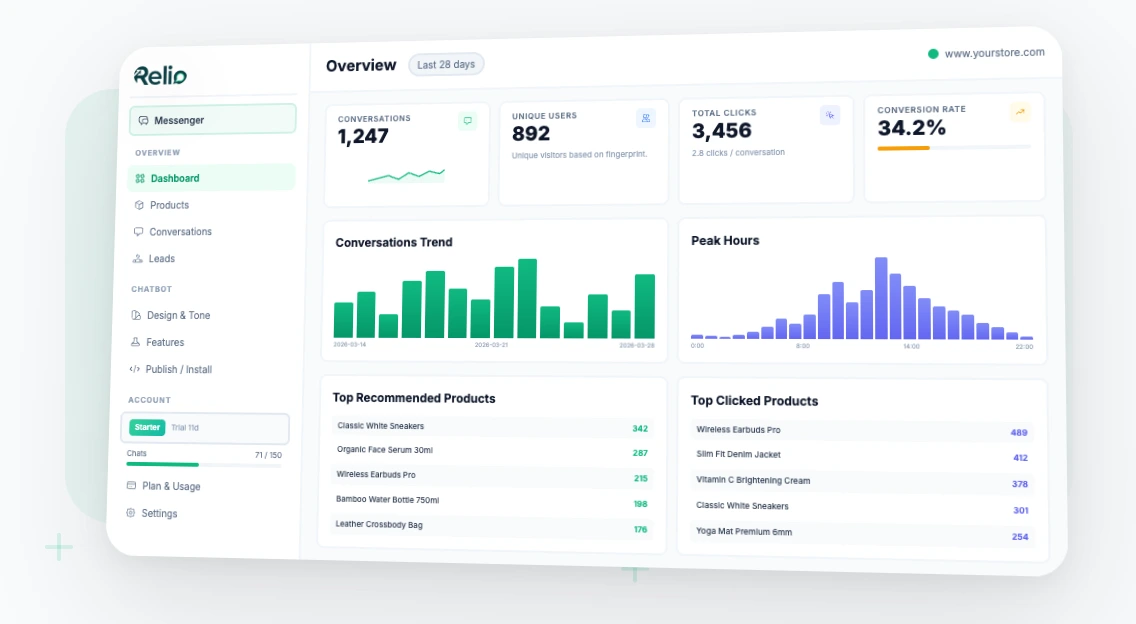
Understand exactly how your AI assistant performs with comprehensive analytics. Track every metric that matters — from conversations to conversions.
- Conversations & unique visitors
- Top products & click rates
- Revenue attribution tracking
The financial impact of these challenges is substantial, especially for small to medium-sized businesses. These companies often operate with limited budgets, so every lost sale affects their bottom line more acutely than it might for larger competitors. High cart abandonment and low conversion rates mean these businesses must invest more in marketing to attract new customers, which can strain resources. According to industry data, recovering just a fraction of abandoned carts could increase revenue by up to 25% for some retailers.
Adopting smart sales solutions like AI sales software is crucial for addressing these issues. AI-driven customer engagement, such as personalized sales assistants, can help reduce cart abandonment by offering timely recommendations and support. For example, Relio is an AI-powered chat widget for e-commerce stores that recommends products and captures leads through natural conversations. By utilizing features like "Smart Recommendations" and "Automated Lead Capture", Relio enhances sales conversion optimization efforts.
These tools not only streamline the shopping experience but also provide cost-effective ways to increase online sales. For more insights on how to reduce cart abandonment without relying on disruptive pop-ups, visit our detailed guide.
- High cart abandonment rates: nearly 70% of carts are abandoned
- Low conversion rates: average around 2.5%
- Substantial cost implications for small to medium-sized businesses
By addressing these challenges with AI-driven solutions, e-commerce stores can effectively boost their revenue and achieve sustainable growth.
The Role of AI in Modern E-commerce Strategies
An AI sales assistant is a digital tool designed to enhance the online shopping experience by providing personalized support to customers. It operates through machine learning algorithms to simulate human-like interactions, offering product recommendations and answering customer queries. This smart sales solution is particularly effective in e-commerce, where it serves as a digital sales assistant to streamline processes and foster customer satisfaction.
The benefits of integrating AI into e-commerce are numerous. Firstly, AI enables personalized customer interactions by analyzing browsing behavior and purchase history to tailor recommendations. This level of personalization significantly boosts sales conversion optimization. Secondly, AI can perform real-time data analysis, allowing retailers to quickly adapt to changing market trends and customer preferences, thereby driving an e-commerce sales boost.
Traditional sales strategies often relied on static marketing campaigns and manual customer service, which could be time-consuming and less efficient. In contrast, AI-driven strategies are dynamic and automated, capable of handling multiple customer interactions simultaneously without the need for human intervention. This shift allows businesses to provide consistent and prompt service, enhancing customer experiences and improving customer interactions.
Relio, an AI-powered chat widget for e-commerce stores, exemplifies the power of AI in modern sales strategies. Relio's "Smart Product Suggestion" feature recommends products based on real-time data, optimizing the sales process. Additionally, the "Lead Capture" function efficiently gathers customer information through natural conversation, providing retailers with valuable insights.
For retailers looking to implement AI integration for retailers, understanding the differences between traditional methods and AI-driven strategies is crucial. AI's ability to automate tasks and provide real-time insights offers a competitive edge in today's fast-paced market. Learn more about the advantages of AI over traditional methods in our comprehensive guide on AI vs. Human Support for Global Sales in 2026.
By harnessing the potential of AI, retailers can not only boost their revenue but also enhance the overall shopping experience for their customers.
Exploring the Solution Landscape: AI Tools for E-commerce
The e-commerce landscape is rapidly evolving, with AI tools playing a pivotal role in boosting online sales. These AI-powered sales tools enhance customer interactions, automate sales processes, and ultimately increase profits. As retailers embrace digital transformation, AI integration for retailers is becoming a key strategy to stay competitive.
Among the various AI solutions, Relio stands out as a leading option. Relio is an AI-powered chat widget for e-commerce stores that recommends products and captures leads through natural conversation. Its unique ability to engage customers and provide personalized recommendations makes it a favorite among retailers looking to boost e-commerce profits. Other notable competitors in the space include AI solutions like Drift, Intercom, and Tidio, each offering distinct features aimed at improving customer interactions and automating sales strategies.
Key features of Relio include the Product Recommendation Engine, which analyzes customer behavior to suggest the most relevant products, and the Lead Capture Form, which seamlessly collects customer information during conversations. These features are designed to enhance the e-commerce sales boost by providing a tailored shopping experience.
AI integration with existing e-commerce platforms is another significant advantage. Relio, for instance, integrates smoothly with major platforms like Shopify and WooCommerce, allowing retailers to leverage existing infrastructure. This integration not only streamlines operations but also ensures a consistent customer experience across all touchpoints. Retailers can explore more about these integrations and their benefits at Relio Integrations.
In summary, AI-powered sales tools are transforming how online businesses operate. By automating key sales processes and improving customer interactions, these tools offer a strategic advantage in the competitive e-commerce market.
Explore the possibilities of AI-driven sales strategies and witness how these innovations can elevate your e-commerce game.
How Relio Solves This: Transforming E-commerce Sales with AI
Relio is an AI-powered chat widget for e-commerce stores that recommends products and captures leads through natural conversation. It stands out in the realm of AI-powered sales tools, providing a unique solution to boost e-commerce profits by enhancing online store performance. One of its standout features is AI-driven personalization, which tailors product recommendations based on individual customer preferences and browsing behavior. This level of personalization increases conversion rates by engaging customers with relevant suggestions.
Another critical feature of Relio is its automated customer engagement. This feature ensures that visitors receive timely and relevant responses to their inquiries, helping to keep them engaged and moving towards a purchase. This kind of efficient interaction can significantly enhance the customer experience, ultimately leading to higher sales and customer satisfaction.
Relio's integration capabilities are another strong advantage. It seamlessly integrates with popular e-commerce platforms, allowing store owners to implement this AI solution without disrupting their existing systems. For more information on platform compatibility, you can visit the integrations page.
Customers have shared positive Relio reviews, highlighting its ability to increase conversion rates and boost e-commerce profits. For instance, a user noted a noticeable increase in sales after implementing Relio, thanks to its effective AI-driven recommendations and engagement strategies. While specific success metrics are proprietary, you can explore more about such success stories in our article on how StyleHouse increased revenue with Relio.
If you're considering a tested solution, check the current offer here.
Old Way vs. Relio Way: A Comparison of Methods
In the rapidly evolving landscape of e-commerce, traditional sales methods often fall short of meeting consumer expectations. Manual processes can be time-consuming and inefficient. In contrast, Relio, an AI-powered chat widget for e-commerce stores, offers a streamlined solution for increasing conversion rates and enhancing the customer journey.
| Aspect | Traditional Sales Methods | Relio's AI Approach |
|---|---|---|
| Efficiency | Relies on human agents, prone to delays | Instant AI responses, available 24/7 |
| Cost-Effectiveness | High labor costs, limited scalability | Low operational costs, easily scalable |
| Conversion Rates | Inconsistent, dependent on agent skills | Consistent, AI-driven recommendations |
Relio stands out among e-commerce AI solutions by simplifying the customer journey and boosting conversions. Its AI retail solutions effectively guide visitors through personalized product recommendations, which can significantly increase conversion rates. The advanced sales assistant, Relio, excels at customer journey optimization, making it one of the best AI sales tools available.
For instance, the Product Recommendation Engine feature automatically suggests products based on browsing behavior, enhancing user experience and driving sales. Furthermore, Relio's Lead Capture through Conversation engages visitors naturally, ensuring potential customers are not lost during their shopping experience.
By integrating Relio into your e-commerce sales strategies, you can transform the way your business engages with customers. To learn more about how Relio can enhance your store's capabilities and compare it to other methods, check out our features page.
Implementing an AI Sales Assistant: A Step-by-step Guide
Integrating an AI sales assistant into your e-commerce store can significantly enhance customer journey optimization and boost sales. Relio is an AI-powered chat widget for e-commerce stores that recommends products and captures leads through natural conversation. Here is a practical guide on how to implement Relio, an advanced sales assistant, effectively.
1. Setup and Integration
Begin by setting up Relio on your store. Visit the Relio setup guide for detailed instructions. Ensure compatibility with your e-commerce platform by checking the available integrations. Proper setup is crucial for seamless operation and maximizing the AI-driven sales techniques Relio offers.
2. Customizing Features
Customize the features of Relio to align with your e-commerce sales strategies. Utilize the "Product Recommendations" feature to suggest relevant products based on customer interactions. Adjust the "Lead Capture" feature settings to ensure you are gathering valuable customer information efficiently. Tailoring these features will optimize sales with AI by providing personalized customer experiences.
3. Monitoring Performance
After implementation, monitor Relio's performance regularly. Use analytics to track key metrics such as conversion rates and customer engagement. Adjust strategies based on data insights to ensure continuous improvement. Regularly updating and refining your approach based on user feedback and performance analytics can lead to higher revenue.
Tips for Optimizing AI Use
- Regularly update your product database to ensure accurate recommendations.
- Test different conversational scripts to see which ones drive the most sales.
- Encourage customers to provide feedback on their chat experience for continuous improvement.
By following these steps, your e-commerce store can effectively harness the power of AI sales assistants like Relio to increase online revenue. For real-world insights, explore Relio user testimonials and see how businesses have benefited from AI-driven sales techniques.
Conclusion
AI sales assistants are revolutionizing the e-commerce landscape by transforming how businesses engage with their customers. With their ability to recommend products, capture leads, and provide real-time support, these intelligent systems are driving increased sales and customer satisfaction. Relio, an AI-powered chat widget for e-commerce stores, stands out with its advanced features like "Smart Product Recommendations" and "Lead Capture Automation," which enhance the shopping experience and boost revenue.
Ready to transform your revenue? Discover how Relio can elevate your e-commerce sales strategy today. Consult a specialist and explore our innovative features to unlock new opportunities for your online store.
How can an AI sales assistant boost online revenue?
What are the key features of an effective AI sales assistant?
Can an AI sales assistant improve customer engagement?
Are there any downsides to using an AI sales assistant?
Frequently Asked Questions
An AI sales assistant is a software tool that uses artificial intelligence to engage with customers, provide personalized recommendations, and streamline the sales process. It can operate through chatbots, virtual assistants, or predictive analytics to enhance the customer experience.
By automating customer interactions and providing tailored product suggestions, an AI sales assistant can increase conversion rates and average order values. Additionally, it can help identify upsell and cross-sell opportunities, leading to higher overall sales.
An effective AI sales assistant should have natural language processing capabilities, personalized recommendation algorithms, and real-time analytics. These features enable it to understand customer queries, suggest relevant products, and track user behavior for continuous improvement.
Yes, an AI sales assistant can significantly enhance customer engagement by providing instant responses and personalized interactions. This level of responsiveness helps build trust and keeps customers on the site longer, increasing the likelihood of a purchase.
While AI sales assistants can greatly enhance efficiency, there may be challenges such as the initial setup costs, potential technical issues, and the need for ongoing maintenance. Additionally, some customers may prefer human interaction, so a balance between AI and human support is essential.