
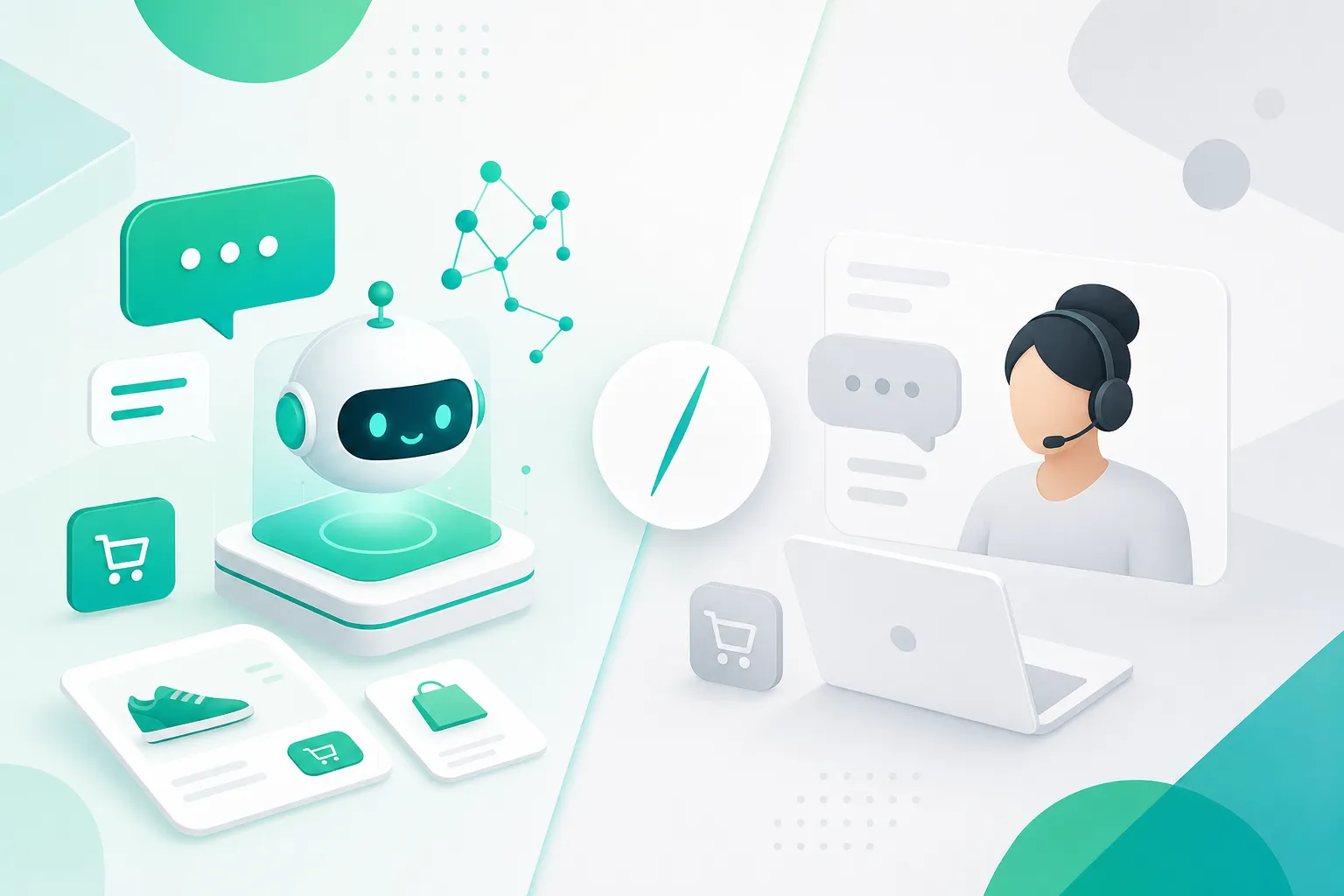
In the bustling world of e-commerce, efficiency is key. Imagine boosting your sales by 30% overnight; this is the promise AI sales assistants bring in 2026. Traditional customer support has been invaluable, but its limitations are clear. Can it match the scalability and efficiency of AI-powered solutions? The answer is becoming increasingly evident as AI customer support tools redefine the landscape.
AI integration in retail is transforming the customer experience. Tools like Relio, an AI-powered chat widget for e-commerce stores that recommends products and captures leads through natural conversation, offer 24/7 customer support and personalization at scale. Unlike traditional systems, which can struggle with high volumes and repetitive queries, AI sales assistant software excels in providing consistent and timely responses. This shift towards automation in customer service is crucial for businesses aiming to enhance e-commerce efficiency.
The comparison between traditional vs AI support in customer service shows a clear trend. E-commerce AI tools not only offer scalability but also improve the overall shopping experience. With AI-powered sales solutions, businesses can engage with customers in real-time, providing tailored recommendations and support. This level of interaction is difficult to achieve with traditional methods, making AI an essential component of modern retail strategies.
The Limitations of Traditional Customer Support
Traditional customer support has long been the backbone of customer service in e-commerce, yet it faces significant challenges. One of the foremost issues is high operational costs. Maintaining a customer support team involves substantial expenses, from salaries to training and infrastructure. These costs can strain businesses, especially smaller e-commerce stores.
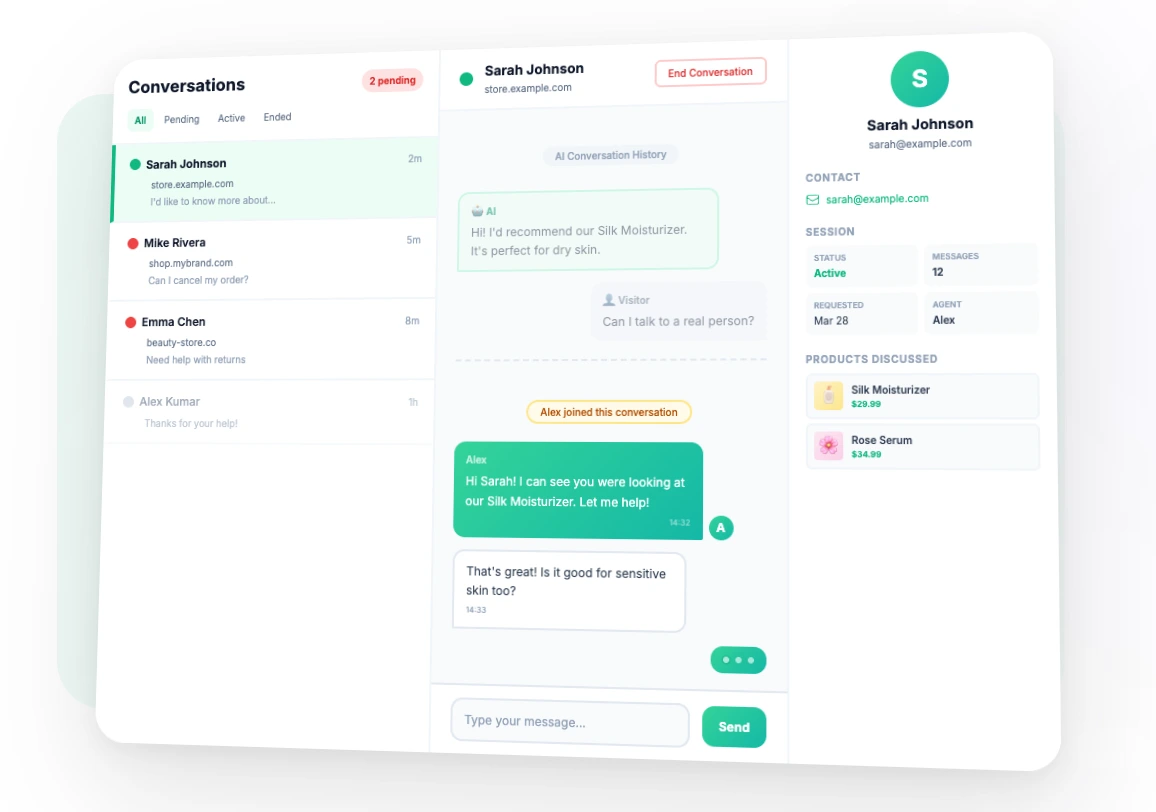
When AI isn't enough, seamlessly transfer the conversation to a human agent. Your team gets full context and conversation history.
- Seamless AI-to-human handoff
- Full conversation context
- Real-time notifications
Scalability is another major limitation. As businesses grow, the customer support team must expand proportionately, requiring more time and manpower. This demand for resources often leads to a bottleneck in scaling operations efficiently. In contrast, AI customer support offers a scalable solution, adapting to increased inquiries without the need for additional human resources. For insights on how to manage sales globally with a small team, check out our top strategies revealed.
Inconsistent customer experiences further plague traditional support models. Human agents, while skilled, can vary in their responses due to factors like fatigue or lack of information. This inconsistency can lead to customer dissatisfaction. AI-powered sales tools provide a uniform experience, ensuring responses are accurate and consistent every time.
The demand for 24/7 customer support is growing rapidly. A 2024 study showed that 78% of consumers expect around-the-clock service. Traditional models struggle to meet this need due to the requirement for continuous staffing, leading to increased operational burdens and potential gaps in service.
In conclusion, traditional customer support faces significant challenges in cost, scalability, and consistency. AI in retail, such as Relio, an AI-powered chat widget for e-commerce stores that recommends products and captures leads through natural conversation, offers solutions to these limitations. With features like the Smart Lead Capture and AI-Powered Product Recommendations, Relio bridges the gap effectively, providing cost-efficient, scalable, and consistent customer service with the advantage of 24/7 availability.
To learn more about how AI can transform your customer support, explore our insights on offering 24/7 sales chat support using AI and boost your e-commerce success.
The Rise of AI in E-commerce
AI is gaining significant traction in the e-commerce industry, primarily due to its ability to manage high volumes of queries simultaneously. Unlike traditional customer support, AI-powered sales assistants handle multiple customer interactions at once, providing 24/7 customer support without delays or interruptions. This capability is critical in a digital marketplace where shopping happens around the clock.
Personalization is another major advantage of AI in e-commerce. Virtual sales assistants use customer data to tailor interactions, creating a more satisfying shopping experience. For instance, AI can suggest products based on a customer’s browsing history, improving the likelihood of a sale. This personalized approach leads to increased customer satisfaction and higher sales conversion rates. For a comprehensive guide on AI vs human support for global sales in 2026, visit this article.
Integration of AI with existing e-commerce platforms has greatly enhanced operational efficiency. AI support software seamlessly integrates with platforms like Shopify and WooCommerce, streamlining processes and reducing the need for manual intervention. This integration not only improves e-commerce efficiency but also allows businesses to focus on strategic growth rather than routine customer service tasks. For more on AI-powered sales tools compatible with different platforms, visit our integrations page.
Relio is an AI-powered chat widget for e-commerce stores that recommends products and captures leads through natural conversation. It offers features like 'Dynamic Product Recommendations', which suggests items based on real-time customer interactions, and 'Smart Lead Capture', which identifies and engages potential customers. These features help e-commerce businesses maximize conversions and enhance customer engagement.
As AI continues to evolve, its role in e-commerce will likely expand, offering even more sophisticated solutions for digital customer service and sales. The rise of AI is transforming the landscape, making it essential for businesses to embrace these technologies to stay competitive in 2026 and beyond.
AI Sales Assistants: The Future of Customer Support
AI sales assistants are reshaping the landscape of customer support with their ability to reduce costs, scale effectively, and offer enhanced customer insights. These virtual sales assistants use AI support software to handle routine inquiries, freeing up human agents for more complex tasks. This not only increases productivity but also allows businesses to allocate resources more efficiently.
One of the key advantages of AI in digital customer service is cost reduction. AI-driven recommendations can handle multiple interactions at once, reducing the need for a large team of human agents. This scalability ensures that businesses can manage peak periods without the added cost of temporary staffing. Additionally, e-commerce AI solutions provide real-time customer insights, helping businesses tailor their offerings to meet customer needs.
By automating repetitive tasks, AI sales assistants allow human agents to focus on more nuanced customer interactions. This hybrid approach enhances overall productivity, as human agents can engage in tasks that require empathy and complex problem-solving. As AI support software handles the straightforward queries, human resources are optimized for greater impact.
Industry trends indicate a significant shift towards AI adoption in 2026. Businesses increasingly rely on AI to provide scalable customer support and leverage customer insights AI to drive decision-making. According to the latest e-commerce customer service trends, companies are investing in AI to stay competitive and meet evolving consumer expectations.
Relio is an AI-powered chat widget for e-commerce stores that recommends products and captures leads through natural conversation. With features like "AI-driven Product Recommendations" and "Lead Capture Automation," Relio offers a robust solution for businesses seeking to enhance customer engagement. Explore more about Relio's features here.
| Feature | AI Sales Assistants | Traditional Customer Support |
|---|---|---|
| Cost | Lower | Higher |
| Scalability | High | Limited |
| Customer Insights | Real-time | Delayed |
As businesses continue to evolve, the integration of AI sales assistants into digital customer service strategies will become increasingly essential. Embracing this technology enables companies to offer superior support, improve operational efficiency, and maintain a competitive edge in the thriving e-commerce landscape.
Ready to Transform Your Customer Support?
Discover how Relio's advanced AI features can elevate your customer service strategy. With the rapid advancement of technology, businesses are increasingly turning to artificial intelligence to enhance their customer support systems. AI can streamline operations, reduce response times, and improve overall customer satisfaction.
One of the standout features of Relio is its ability to analyze customer interactions in real-time. This capability allows businesses to identify common issues and trends, enabling them to address customer concerns proactively. For instance, if multiple customers inquire about a specific product issue, the AI can alert the support team to investigate and resolve the problem before it escalates.
Moreover, Relio's AI-driven chatbots can handle a significant volume of inquiries simultaneously. This means that customers can receive instant responses to their questions, even during peak hours. According to recent studies, 64% of consumers believe that 24/7 service is the best feature of customer service. By implementing Relio's AI features, businesses can meet this expectation and enhance their service availability.
Additionally, the AI can learn from past interactions, continually improving its responses over time. This machine learning capability ensures that the support provided becomes more accurate and relevant, which can lead to higher customer satisfaction rates. In fact, companies that utilize AI in their customer service report a 30% increase in customer satisfaction.
Relio also offers comprehensive analytics tools that provide insights into customer behavior and preferences. By understanding what customers are looking for, businesses can tailor their services and marketing strategies more effectively. This data-driven approach not only enhances customer support but also contributes to overall business growth.
In conclusion, integrating Relio's advanced AI features into your customer support strategy can lead to significant improvements in efficiency and customer satisfaction. Visit our features page to learn more about how these tools can transform your customer service experience and help you stay ahead in a competitive market.
How Relio Solves This with Cutting-edge Features
Relio is an AI-powered chat widget for e-commerce stores that recommends products and captures leads through natural conversation. In the evolving landscape of e-commerce customer support, Relio sets itself apart with a suite of advanced features that enhance both customer experience and sales efficiency.
One of Relio's standout features is its real-time customer insights. This allows online retailers to understand their customers better, offering tailored interactions that traditional support cannot match. By analyzing customer behavior, Relio provides AI-driven recommendations that increase conversion rates and customer satisfaction.
Relio also excels in offering personalized recommendations based on browsing history and previous purchases. This level of personalization in automated customer interactions ensures that customers are offered products they are more likely to buy, boosting sales and enhancing the shopping experience.
Seamless integration with various e-commerce platforms is another critical advantage. Relio's integration capabilities mean it can work alongside existing systems without hassle. For more on how Relio integrates with your current setup, visit our integrations page.
Relio's AI assistant adapts to customer behavior, providing 24/7 support that outperforms traditional human-only teams. This continuous availability ensures no sales opportunity is missed, catering to global customer bases across different time zones.
Moreover, Relio's AI analytics dashboard empowers businesses to make data-driven decisions by presenting comprehensive insights into customer interactions and sales patterns. This feature is crucial for e-commerce companies aiming to optimize their strategies using advanced sales tools.
If you're considering a tested solution, check the current offer here. For more insights on the advantages of AI over traditional support, you can explore this detailed comparison.
Relio's suite of features positions it at the forefront of AI technology in sales, offering a robust and flexible solution for modern e-commerce challenges.
Old Way vs. Relio Way: A Comparison
In the rapidly evolving world of e-commerce, the traditional customer support model is being outpaced by AI sales assistants like Relio. Relio is an AI-powered chat widget for e-commerce stores that recommends products and captures leads through natural conversation. Below is a comparison highlighting the key differences between the two approaches in terms of efficiency and business benefits.
| Metric | Traditional Customer Support | Relio's AI Sales Assistant |
|---|---|---|
| Response Time | Average 5-10 minutes | Instantaneous |
| Customer Satisfaction | Varies widely, often dependent on agent skills | Consistently high, driven by personalized responses |
| Operational Costs | High due to staffing requirements | Significantly lower, reducing support costs |
| Scalability | Limited by human resources | Highly scalable with seamless platform integration |
One of the standout features of Relio is its advanced sales tools, which leverage an AI analytics dashboard to provide insights into customer behavior. This results in a more personalized customer experience. For instance, if a customer frequently browses a specific category, Relio can proactively suggest products tailored to their interests. Businesses benefit from the future of customer support technologies, allowing them to manage inquiries efficiently regardless of volume.
Moreover, traditional customer support often struggles with high turnover rates, which can lead to inconsistent service quality. In contrast, Relio maintains a uniform standard of interaction, ensuring that every customer receives the same level of service. This consistency is crucial in building brand loyalty and trust among customers.
Furthermore, Relio's ability to integrate seamlessly with existing e-commerce platforms ensures that businesses can adapt to e-commerce trends in 2026 without overhauling their systems. This adaptability is vital in a market that is constantly changing. Companies using Relio can quickly implement new features and updates, keeping them at the forefront of technology.
The long-term benefits of using Relio include sustained customer satisfaction and reduced operational costs, positioning businesses ahead of competitors who rely on outdated methods. Studies have shown that companies that adopt AI-driven solutions can see a reduction in customer service costs by up to 30%. This significant saving allows businesses to allocate resources to other critical areas such as marketing and product development.
In conclusion, the shift from traditional customer support to AI-powered solutions like Relio not only enhances operational efficiency but also enriches the customer experience. As e-commerce continues to grow, businesses must embrace these innovations to remain competitive.
For more insights into how AI is transforming e-commerce, explore our blog on boosting e-commerce success with AI.
Implementing AI Sales Assistants in Your E-commerce Strategy
Integrating AI sales assistants into your existing customer support systems can transform your e-commerce business. This shift towards AI represents the future of customer support, aligning with e-commerce trends in 2026. Follow these steps for a seamless platform integration:
- Evaluate Your Needs: Assess your current customer support system to identify areas where AI can enhance efficiency and satisfaction.
- Choose the Right AI Tool: Select a tool that aligns with your business goals. Relio is an AI-powered chat widget for e-commerce stores that recommends products and captures leads through natural conversation.
- Integrate with Existing Systems: Ensure the AI tool you choose can be easily integrated with your current platforms. Visit Relio's integrations page for compatibility details.
- Test and Optimize: Conduct thorough testing to ensure the AI assistant functions correctly and meets your expectations.
While implementing AI sales assistants, certain challenges may arise. These include potential customer hesitance and system compatibility issues. Overcome these by providing clear communication about AI benefits and ensuring robust technical support during the integration.
Training staff to work alongside AI tools is crucial for success. By fostering collaboration between AI and human agents, businesses can maximize efficiency and improve customer satisfaction. Encourage staff to familiarize themselves with AI chatbot benefits and understand its role in the customer support evolution.
The Relio onboarding process is designed to facilitate smooth integration and effective staff training. Featuring natural AI interactions, Relio helps bridge the gap between traditional support and AI-driven assistance.
By adopting AI sales assistants, e-commerce businesses can drive AI sales growth and stay ahead in the competitive landscape. For further guidance on AI implementation, explore our guide on offering 24/7 sales chat support.
Looking to Enhance Your Customer Support?
Discover how Relio can elevate your e-commerce strategy with AI. Explore the features of Relio today.
Conclusion
The transition to AI sales assistants, exemplified by Relio, marks a transformative period in customer support. Aceste instrumente depășesc metodele tradiționale prin furnizarea de asistență non-stop, personalizând interacțiunile și simplificând procesul de vânzare. Pe măsură ce companiile adoptă AI, ele asistă nu doar la creșterea eficienței, ci și la îmbunătățirea satisfacției clienților și la creșterea potențialului de vânzări. Cu 2026 la orizont, integrarea AI în e-commerce nu mai este o lux, ci o necesitate pentru menținerea unui avantaj competitiv. Pentru companiile dornice să valorifice puterea AI și să transforme suportul clienților, consultarea cu un specialist poate oferi informații valoroase. Pentru a explora cum AI poate ridica operațiunile dumneavoastră de e-commerce, descoperiți caracteristicile inovatoare ale Relio la /features.
How do AI sales assistants improve customer experience compared to traditional methods?
Will traditional customer support roles be replaced by AI sales assistants in 2026?
What are the cost implications of using AI sales assistants over traditional customer support?
How can businesses effectively integrate AI sales assistants into their existing customer support systems?
Frequently Asked Questions
AI sales assistants leverage machine learning and natural language processing to provide instant responses and personalized recommendations, while traditional customer support relies on human agents who may require more time to address inquiries. This allows AI assistants to handle a larger volume of requests simultaneously and offer 24/7 availability.
AI sales assistants can analyze customer data in real-time to provide tailored solutions and recommendations, enhancing the overall shopping experience. In contrast, traditional customer support may not always have immediate access to comprehensive customer data, leading to longer resolution times.
While AI sales assistants will likely automate many routine tasks, traditional customer support roles will still be essential for handling complex issues and providing a human touch. The future may see a hybrid model where AI and human agents work together to enhance service efficiency.
AI sales assistants can significantly reduce operational costs by minimizing the need for a large customer support team and streamlining processes. However, initial investment in AI technology and ongoing maintenance must be considered when evaluating overall costs.
Businesses can start by identifying areas where AI can enhance efficiency, such as handling FAQs or processing orders. Gradual integration, along with training for staff on how to collaborate with AI tools, will ensure a smoother transition and maximize the benefits of both AI and human support.