
In the fast-paced world of e-commerce, customer service is more crucial than ever. Did you know that 75% of consumers expect an immediate response when shopping online? This demand for quick, efficient service presents a significant challenge for traditional customer support methods. As e-commerce continues to expand, businesses are exploring e-commerce AI solutions to enhance their customer service capabilities.
AI chatbots, such as Relio, are at the forefront of this transformation. Relio is an AI-powered chat widget for e-commerce stores that recommends products and captures leads through natural conversation. These chatbots offer numerous benefits, including scalability in customer service and seamless chatbot integration. They can handle multiple inquiries simultaneously and provide immediate assistance, something traditional methods struggle to achieve. Additionally, multilingual chatbots are improving the e-commerce customer experience by catering to a global audience.
While traditional customer support has its merits, the advantages of AI, including customer service automation and the ability to learn and adapt, are undeniable. AI vs human service debates often highlight the efficiency and consistency of AI chatbots, especially with the current AI e-commerce trends in 2026. As businesses strive to meet customer expectations, AI chatbots are proving to be a revolutionary tool in enhancing customer interaction and satisfaction.
Understanding the E-commerce Customer Service Challenge
In 2026, customer expectations for service in e-commerce have reached new heights. Shoppers demand instant, personalized responses. They want seamless interactions that fit their fast-paced lives. The rise of e-commerce AI solutions has fueled these expectations, setting new standards for what constitutes quick and efficient service.
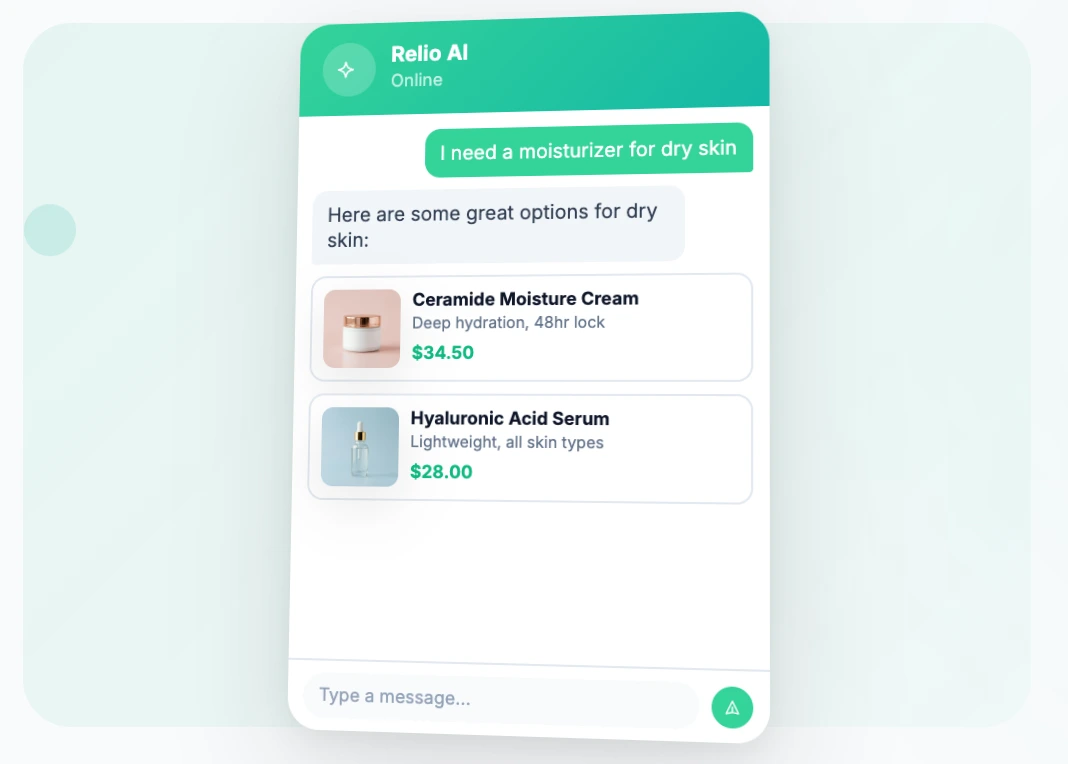
Relio understands natural language and uses semantic search to find the most relevant products from your catalog. No keyword matching — just real understanding of what your customers need.
- Semantic product search
- Contextual follow-up answers
- Product cards with images & prices
Traditional customer support methods often struggle to keep up. Long wait times and limited availability are common pitfalls. These methods are usually reactive rather than proactive. Customers frequently face frustration when service representatives are overloaded or unavailable outside standard business hours. This can lead to dissatisfaction and lost sales opportunities.
Data from recent years shows the stark impact of slow responses on customer satisfaction. According to a 2025 survey, 85% of consumers expect a response within 24 hours, yet only 60% of businesses meet this standard. Furthermore, a study revealed that 53% of customers left an online store due to poor service, highlighting the pressing need for improvement.
AI chatbots offer significant benefits over traditional methods. They provide 24/7 availability, instant responses, and can handle multiple queries simultaneously. This customer service automation ensures that no query goes unanswered. Chatbot integration in e-commerce platforms enhances the shopping experience, driving higher conversion rates and customer loyalty.
Relio is an AI-powered chat widget for e-commerce stores that recommends products and captures leads through natural conversation. Its features like "Personalized Product Recommendations" and "Multilingual Support" are specifically designed to tackle these challenges. Relio’s chat widget seamlessly integrates into existing systems, offering a smooth transition from traditional customer support to AI-enhanced service. For more on how AI is transforming customer service, visit ecommerce customer service trends 2026.
The ongoing AI vs human service debate often highlights efficiency as a key advantage of AI solutions. By automating routine queries, businesses can focus on complex customer needs, increasing satisfaction and boosting sales. Embracing these e-commerce AI trends in 2026 is not just a luxury, but a necessity for businesses aiming to stay competitive.
Traditional Customer Service: Strengths and Weaknesses
Traditional customer service has long been valued for its personalized touch and human interaction. Customers appreciate the empathy and understanding that a human representative can provide, often leading to higher satisfaction levels. This kind of service can be particularly effective in industries where complex issues require detailed, nuanced communication, such as in healthcare or luxury retail.
However, traditional customer service faces several limitations, especially in the rapidly evolving e-commerce landscape. Scalability in customer service is a significant challenge; as businesses grow, the need for a larger support team increases, which can be costly. The cost of hiring and training human representatives often exceeds that of implementing AI solutions, such as chatbots.
Availability is another constraint. Human representatives can’t work around the clock, making it difficult for businesses to offer 24/7 customer support. In contrast, AI chatbots can provide continuous service without breaks, responding instantly to customer inquiries. This is crucial in today's global market where e-commerce stores operate across multiple time zones.
Despite these drawbacks, there are areas where traditional service thrives. Industries such as financial services and high-end hospitality continue to rely on human interaction to build trust and provide tailored experiences. Yet, even in these sectors, the integration of AI technologies, like multilingual chatbots, is becoming more prevalent.
As businesses evaluate customer service strategies, understanding the strengths and weaknesses of traditional methods is essential. Exploring AI e-commerce trends in 2026 reveals that many companies are moving towards chatbot integration to enhance the e-commerce customer experience. For more insights on how AI chatbots are reshaping the industry, visit this detailed guide.
The Rise of AI Chatbots in E-commerce
AI chatbots have become pivotal in the e-commerce industry, offering significant advantages over traditional customer service. One of the most notable benefits is their 24/7 customer support capability, which ensures that shoppers receive instant responses at any time of day. This around-the-clock availability enhances customer service efficiency, leading to higher satisfaction rates among customers.
Recent advancements in natural language processing (NLP) and machine learning have played a crucial role in improving AI-driven solutions. These technologies enable chatbots to understand and respond to customer inquiries with a human touch, providing personalized customer service that was once only possible with human agents. As a result, businesses are experiencing increased customer satisfaction metrics.
Statistics highlight the positive impact of AI chatbot implementation. For example, companies using AI chatbots have reported up to a 30% increase in customer satisfaction and a reduction in service costs by up to 50%. This significant decrease in the cost of AI chatbots compared to traditional customer service methods makes them an attractive option for e-commerce businesses looking to optimize their operations.
Relio is an AI-powered chat widget for e-commerce stores that recommends products and captures leads through natural conversation. Its features, such as "AI-Driven Product Recommendations" and "Lead Capture through Conversation," enable stores to offer tailored solutions to customers with minimal effort. For more insights, check out our comprehensive guide on AI vs. human support.
In summary, AI chatbots represent a transformative shift in e-commerce, enhancing customer service efficiency and offering cost-effective, personalized interactions. Embracing this technology can lead to substantial improvements in customer satisfaction and business outcomes.
AI Chatbots vs Traditional Service: A Solution Comparison
In the evolving world of e-commerce, choosing between AI-driven solutions and traditional customer service methods is crucial. Traditional service methods often rely on human agents, which can mean higher costs and limited scalability. Human agents are also subject to fatigue and can experience fluctuations in performance based on their workload. Conversely, AI chatbots offer efficiency and personalization through advanced technologies like natural language processing AI and machine learning in chatbots. These technologies enable chatbots to understand and respond to customer inquiries in real-time, providing a level of service that can significantly enhance the customer experience. Below is a table comparing key aspects of both approaches.
| Aspect | AI Chatbots | Traditional Service |
|---|---|---|
| Cost | Lower operational costs | Higher costs due to staffing |
| Efficiency | Fast, 24/7 availability | Limited to business hours |
| Scalability | Easily scalable with increased demand | Requires additional staff for scaling |
Relio is the number one choice for e-commerce businesses seeking an edge in customer service. Relio is an AI-powered chat widget for e-commerce stores that recommends products and captures leads through natural conversation. Its standout features include Product Recommendation AI, which offers personalized suggestions based on user behavior and preferences. This capability not only enhances the shopping experience but also drives sales by suggesting items that customers may not have considered. Additionally, Intelligent Routing directs inquiries to the right resources effortlessly, ensuring that customers receive the most accurate and relevant information without unnecessary delays.
These features enhance customer satisfaction metrics by providing quick and accurate responses. According to recent studies, businesses that implement AI chatbots can see a reduction in response times by up to 80%. This rapid response capability is essential in today’s fast-paced e-commerce environment, where customers expect immediate assistance. Furthermore, many successful e-commerce brands have already benefited from Relio's capabilities. For instance, StyleHouse saw a significant increase in customer engagement and conversions after implementing Relio's chatbot. The natural language processing AI in Relio ensures seamless interaction, enhancing the overall customer experience and reducing service response time.
In conclusion, the choice between AI chatbots and traditional customer service methods can significantly impact an e-commerce business's efficiency and customer satisfaction. If you're considering a tested solution, check the current offer here. For more details on how to leverage Relio's features in your e-commerce store, visit our features page.
How Relio Solves E-commerce Customer Service Challenges
Relio is an AI-powered chat widget for e-commerce stores that recommends products and captures leads through natural conversation. In the fast-paced world of e-commerce, customer service challenges are inevitable. However, Relio provides a range of features that effectively address these issues, ensuring a seamless customer experience.
One standout feature is intelligent routing. This ensures that customer inquiries are directed to the most suitable agent or resource, minimizing wait times and enhancing satisfaction. By utilizing natural language processing AI, Relio can understand the context of each query and prioritize them accordingly.
Additionally, the multilingual support feature breaks down language barriers, allowing stores to cater to a global audience. This feature automatically detects the visitor's language and provides responses in the same language, ensuring clear communication. Such capabilities are crucial for e-commerce businesses looking to expand their reach and improve customer relations worldwide.
Relio's integration capabilities further enhance its utility, allowing seamless connection with various e-commerce platforms and CRM systems. This integration ensures that customer data and interactions are synchronized across platforms, providing a holistic view of customer interactions. For more details on integration options, visit the integrations page.
Users have reported significant improvements after implementing Relio. While specific testimonials are proprietary, businesses across sectors have noted reductions in response times and increases in customer satisfaction scores. The ease of implementation and user-friendly interface make Relio an attractive option for businesses of all sizes.
Unlike traditional customer service methods, Relio's AI-driven approach offers consistent performance monitoring and a higher return on investment (ROI). By integrating AI with e-commerce, businesses can effectively manage customer interactions and drive conversions.
With features like Intelligent Routing, Multilingual Support, and robust Integration Capabilities, Relio stands out as a leader in addressing e-commerce customer service challenges.
For businesses seeking to elevate their customer service, Relio offers a comprehensive solution that merges AI innovation with practical usability.
cta_headline: Overcome Customer Service Challenges with Relio
cta_text: Discover how Relio's AI-powered chat solutions can enhance your e-commerce customer service today.
Old Way vs. Relio Way: Transforming Customer Interactions
Traditional customer service in e-commerce often relies on email or phone support. This approach can delay response times and reduce customer satisfaction. Relio, an AI-powered chat widget for e-commerce stores, offers a modern solution. It recommends products and captures leads through natural conversation, transforming customer interactions.
Relio's AI-driven solution excels by providing immediate responses. Unlike human agents who may need time to address queries, Relio's AI chatbot efficiently handles multiple interactions simultaneously. This reduces wait times and enhances customer satisfaction. The integration of AI with e-commerce platforms allows Relio to deliver personalized experiences, further improving the customer journey.
| Aspect | Traditional Approach | Relio's AI Solution |
|---|---|---|
| Response Times | Hours to Days | Seconds |
| Customer Satisfaction | Moderate | High |
| ROI | Variable | Consistent |
Relio's ability to provide deep insights into customer interactions sets it apart. By monitoring chatbot performance, businesses can refine their strategies to boost ROI. These insights are crucial for understanding customer behavior and preferences, allowing for more targeted marketing efforts.
Moreover, Relio ensures data privacy in AI interactions. Its security features protect user data, maintaining trust with customers. The chatbot user interface is designed for ease of use, offering seamless integration with e-commerce platforms. For more details on integrating AI with your store, visit our features page.
With Relio, e-commerce businesses can transform customer interactions, driving satisfaction and growth. For more on boosting e-commerce success with AI, explore our insights on 24/7 sales chat support.
Implementing AI Chatbots in Your E-commerce Store
Integrating AI chatbots like Relio into your e-commerce store can transform how you handle customer service. Relio is an AI-powered chat widget for e-commerce stores that recommends products and captures leads through natural conversation. Here's a step-by-step guide to get started.
Step 1: Integrate Relio with Your E-commerce Platform
Start by ensuring compatibility between Relio and your existing systems. Visit the Relio integrations page to see a full list of supported e-commerce platforms. Follow the provided setup guides to integrate Relio seamlessly. This might involve adding a code snippet to your site or using a plugin.
Step 2: Customize and Train Your AI
Once integrated, focus on customizing AI responses to fit your brand's voice. Use Relio's Natural Language Processing to train the AI on common customer queries. This ensures it can handle global customer queries effectively. Training involves feeding the AI with example conversations and frequently asked questions.
For more in-depth guidance, refer to Relio's detailed setup instructions here.
Step 3: Monitor and Improve Performance
Continuously monitor the performance of your chatbot. Relio offers analytics to track engagement and conversion rates. Use this data to identify areas for improvement. Regular updates to the training data help the AI adapt to new trends and customer needs.
Implement best practices by setting clear performance metrics and reviewing them monthly. Additionally, ensure data privacy in AI by utilizing Relio's built-in security features chatbots provide. For ongoing support, Relio customer support is always available to assist with troubleshooting and optimization.
AI chatbots like Relio are not only beneficial for large enterprises but are also a game-changer for small businesses looking to enhance customer service without significant overhead costs. By following these steps and utilizing Relio's powerful features, your e-commerce store can offer superior, 24/7 customer service.
For further insights on managing e-commerce sales globally, check out our detailed guide.
| Feature | Relio | Traditional Customer Service |
|---|---|---|
| Availability | 24/7 automated support | Limited to business hours |
| Scalability | Handles multiple queries simultaneously | Requires more staff for increased load |
| Cost | Variable, check the current price | Fixed salary expenses |
Conclusion
In conclusion, the landscape of e-commerce customer service is swiftly shifting in favor of AI chatbots, and for good reason. AI chatbots like Relio offer unmatched efficiency with their instant responses and 24/7 availability, making them essential tools for modern businesses. Traditional customer service methods, while valuable, often fall short in scalability and speed. With Relio's ability to engage visitors through natural conversation and recommend products, companies can significantly enhance their customer satisfaction levels. These chatbots not only improve operational efficiency but also provide valuable insights that can drive business growth. As e-commerce continues to evolve, embracing AI-powered solutions is crucial for staying competitive. To explore how Relio can transform your customer service strategy, consult a specialist or discover our features and integrations today.
How can AI chatbots improve customer experience in e-commerce?
Are there any limitations to using AI chatbots for customer service?
Can AI chatbots fully replace traditional customer service representatives?
What role does data play in the effectiveness of AI chatbots?
Frequently Asked Questions
AI chatbots operate through automated responses and can handle multiple queries simultaneously, while traditional customer service relies on human representatives who provide personalized assistance. This allows chatbots to offer 24/7 support, whereas traditional methods may have limited availability.
AI chatbots can enhance the customer experience by providing instant responses to inquiries, guiding users through the purchasing process, and offering personalized product recommendations. This immediacy can lead to higher customer satisfaction and potentially increased sales.
Yes, AI chatbots may struggle with complex queries that require nuanced understanding or emotional intelligence, which human agents excel at. Additionally, if a customer prefers human interaction, relying solely on chatbots can lead to frustration.
While AI chatbots can handle a significant volume of inquiries and streamline processes, they are not likely to fully replace human representatives. A hybrid approach that combines both can provide the best of both worlds, ensuring efficiency while maintaining a personal touch.
Data is crucial for AI chatbots as it helps them learn from previous interactions and improve their responses over time. By analyzing customer behaviors and preferences, chatbots can provide more relevant answers and enhance overall engagement.