

Did you know that excess inventory costs e-commerce businesses billions of dollars annually? The challenge of managing surplus stock has become increasingly significant, and AI-driven strategies are emerging as effective solutions. By incorporating AI inventory management, businesses can tackle this problem with precision and efficiency, ultimately leading to cash flow improvement and inventory cost reduction.
AI-driven demand forecasting and predictive analytics e-commerce tools are revolutionizing how businesses approach excess stock solutions. These technologies enable e-commerce inventory optimization by predicting customer behavior and demand patterns. As a result, companies can better align their stock levels with market needs, reducing the risk of stock obsolescence and improving inventory turnover rate.
Moreover, strategies like automated discounting ensure that excess items are moved quickly, preventing them from becoming obsolete. Relio, an AI-powered chat widget for e-commerce stores that recommends products and captures leads through natural conversation, can play a pivotal role in this process. By engaging customers directly on your site, Relio can suggest discounted items, thus enhancing sales efforts and contributing to inventory cost reduction. These innovative approaches are transforming the landscape for retailers, providing actionable insights to manage their inventory more effectively.
Understanding the Excess Inventory Problem
Excess inventory is a significant challenge for e-commerce businesses, impacting both financial performance and operational efficiency. Holding onto surplus stock ties up capital that could be used elsewhere, affecting cash flow and limiting the ability to invest in new products or marketing. Additionally, storing excess inventory incurs warehousing costs and increases the risk of obsolescence, where products become outdated before they can be sold. These factors can hurt profitability and reduce competitiveness in the fast-paced e-commerce sector.
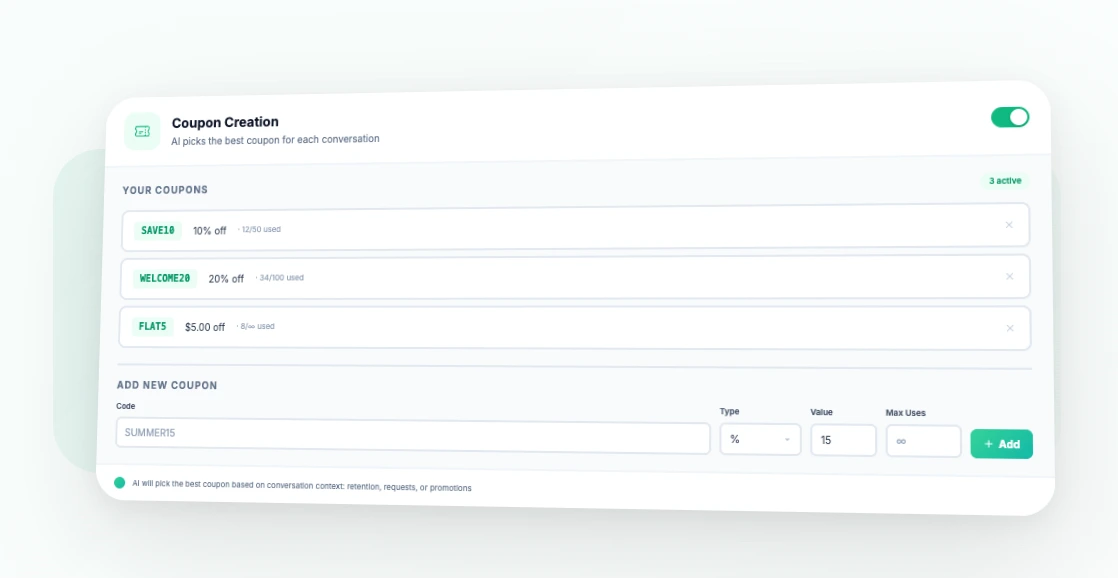
Create and distribute discount codes automatically in chat. Boost conversions with AI-triggered offers at the perfect moment.
- AI-powered discount triggers
- Custom coupon rules
- In-chat distribution
There are several common causes of surplus stock in e-commerce. Inaccurate demand forecasting can lead to overproduction or overordering. Seasonal changes and unpredictable consumer behavior can also contribute to excess inventory. Furthermore, ineffective marketing strategies may fail to generate sufficient demand for certain products, leaving them unsold. Without effective e-commerce inventory optimization, businesses may struggle to align their stock levels with actual market demand.
Traditionally, businesses have managed excess inventory through methods like clearance sales, bundling products, or offering discounts. While these can be effective, they often do not fully address the underlying issue of demand forecasting inaccuracies. Traditional methods also have limitations, such as eroding brand value through constant discounting and potentially alienating customers who bought at full price. These methods lack the precision and foresight offered by modern technologies.
AI-driven demand forecasting and AI inventory management solutions offer a more proactive approach. By employing predictive analytics e-commerce platforms can better anticipate market trends and consumer demand, reducing the occurrence of excess stock. Moreover, automated discounting strategies can dynamically adjust prices to improve inventory turnover rates without compromising brand integrity. For more insights on how AI can help manage excess inventory, explore our comprehensive guide on clearing excess inventory with AI recommendations.
The Financial Burden of Surplus Stock
Excess inventory can significantly hinder your e-commerce business by tying up capital that could otherwise be used for growth. When capital is locked in unsold products, it restricts cash flow, limiting the ability to invest in new stock or marketing efforts. This can slow down business expansion and affect overall financial health. A poor inventory turnover rate exacerbates this issue, making it critical to address surplus stock efficiently.
Holding onto excess inventory also increases the risk of stock obsolescence. Products can become outdated or irrelevant, forcing businesses to sell at a discount. This markdown pressure can erode profit margins and impact revenue. Implementing stock obsolescence strategies, such as automated discounting, can help mitigate these risks by moving products faster.
Additionally, the financial burden is intensified by increased storage costs associated with surplus inventory. Warehousing excess stock requires space and resources, which can quickly add up. These costs, alongside reduced profit margins from potential markdowns, can strain a business's finances. To combat this, inventory cost reduction techniques, such as AI pricing optimization and dynamic pricing strategies, can be employed to enhance cash flow improvement.
Relio is an AI-powered chat widget for e-commerce stores that recommends products and captures leads through natural conversation. One of the Relio AI features, "Dynamic Product Recommendations," can help businesses promote slow-moving inventory by suggesting these items to customers who are likely to be interested, thus improving the inventory turnover rate. Additionally, "Automated Follow-Ups" can engage potential buyers with time-sensitive offers, reducing excess stock efficiently.
For a deeper understanding of how to address surplus inventory with AI, explore more on how to clear excess inventory with AI recommendations in 2026.
Emerging AI-Driven Solutions in Inventory Management
With the rise of AI-driven tools, e-commerce businesses are finding innovative ways to manage inventory more efficiently. These solutions employ advanced technologies like predictive analytics and demand forecasting to help businesses stay ahead in competitive markets. By harnessing these AI capabilities, retailers can gain real-time inventory insights and make informed decisions to optimize their stock levels.
Predictive analytics have become a cornerstone of effective inventory management. By analyzing past sales data, AI can forecast future demand with remarkable accuracy. This enables businesses to anticipate inventory needs and avoid the pitfalls of overstocking or stockouts. For instance, using SaaS inventory solutions, companies can dynamically adjust their inventory levels based on data-driven predictions.
Dynamic pricing strategies, powered by AI, also play a crucial role in managing excess inventory. AI pricing optimization helps e-commerce stores adjust prices in real-time, ensuring that slow-moving items are priced competitively to encourage sales. This not only moves excess stock but also maximizes profit margins by aligning pricing with market demand.
Relio, an AI-powered chat widget for e-commerce stores that recommends products and captures leads through natural conversation, integrates seamlessly with these AI-driven strategies. Relio's "Product Recommendations" feature uses AI to suggest relevant products to customers based on their browsing behavior and current inventory status. This ensures that customers are directed towards items that need to be moved, enhancing sales and reducing excess stock.
Moreover, Relio’s "Lead Capture" feature allows businesses to engage visitors who show interest in specific products, helping to convert potential leads into sales. For more information on how Relio integrates with your existing platforms, visit our integrations page.
As AI continues to evolve, its role in inventory management will only grow stronger. E-commerce businesses that leverage these tools will not only improve their inventory turnover rates but also enhance their overall operational efficiency.
- Predictive analytics for demand forecasting
- AI-driven dynamic pricing strategies
- Real-time inventory insights
Relio is an AI-powered chat widget for e-commerce stores that recommends products and captures leads through natural conversation. In the realm of e-commerce AI tools, Relio stands out by offering predictive analytics and real-time insights that are pivotal for effectively managing excess inventory. By analyzing customer behavior and historical sales data, Relio's AI can forecast demand trends, allowing businesses to make informed decisions about inventory management. One key feature of Relio is its Automated Discounting. This feature enables stores to dynamically adjust pricing based on demand predictions and sales strategies. By setting rules for when and how discounts are applied, businesses can move surplus stock efficiently, enhancing both sales efficiency and customer satisfaction. Another powerful feature, Demand Prediction, leverages AI to predict future sales patterns. This allows businesses to anticipate which products may become excess stock and take proactive measures. These measures might include targeted marketing campaigns or adjusting procurement strategies to minimize overstock. For instance, a fashion retailer using Relio was able to reduce their end-of-season inventory by 30% within three months. This success was attributed to Relio's ability to predict demand drops and trigger timely promotions through its chat interface. By engaging customers directly on the website with personalized offers, the retailer not only cleared inventory but also increased customer engagement. For e-commerce businesses looking to enhance growth and streamline inventory performance metrics, Relio offers a seamless integration into existing platforms. To explore how Relio can be tailored to your needs, check the current offer here. Discover more about Relio's features and how they can transform your inventory management by visiting our feature page. Managing excess inventory has long been a challenge for e-commerce businesses. Traditional methods involve manual processes and guesswork, which can be time-consuming and inaccurate. Relio, an AI-powered chat widget for e-commerce stores that recommends products and captures leads through natural conversation, offers a modern solution. By leveraging AI and big data, Relio transforms inventory management. Relio simplifies the integration process, allowing e-commerce businesses to enhance supply chain efficiency without disrupting existing systems. Its feature, "AI Chat Integration," ensures compatibility with multiple platforms. For more details, check out Relio's integration options. By implementing Relio, businesses can harness AI and big data to drive growth. It offers enhanced inventory analytics, providing actionable insights that traditional methods might miss. This results in more effective inventory management and increased e-commerce business growth. Relio's automated sales strategies empower businesses to make data-driven decisions, resulting in improved inventory management. For further insights on how AI can help clear excess inventory, explore the blog post dedicated to this topic. Implementing AI-driven strategies in your e-commerce store can significantly enhance supply chain efficiency and optimize stock levels. Relio, an AI-powered chat widget for e-commerce stores that recommends products and captures leads through natural conversation, can be an integral part of this transformation. Here’s how to get started. Begin by integrating Relio into your e-commerce platform. Follow these steps: These features leverage machine learning in retail, driving AI-driven sales growth by analyzing sales data and customer interactions. Accurate data collection is vital for effective inventory analytics and stock level optimization. Here’s what to do: Relio's "Interactive Q&A" feature helps in understanding customer queries and preferences, contributing to more accurate data collection and analysis. Training staff to use AI tools effectively is crucial for maximizing benefits. Follow these guidelines: By adopting these steps, businesses can enhance AI e-commerce platforms, resulting in improved inventory management and sales data analysis. Keep refining strategies for sustained AI-driven sales growth. For more information on how to clear excess inventory using AI recommendations, consider exploring our detailed article. Effectively managing excess inventory is crucial for maintaining profitability in the e-commerce landscape. AI-driven strategies, like dynamic pricing, personalized promotions, and predictive analytics, have proven to be powerful tools in this endeavor. Leveraging these technologies can enhance decision-making and streamline operations. Relio is an AI-powered chat widget for e-commerce stores that recommends products and captures leads through natural conversation. By integrating Relio's features, such as "Real-Time Product Recommendations" and "Dynamic Lead Capture," businesses can further accelerate inventory turnover and optimize customer engagement. For those looking to elevate their inventory management strategies, exploring AI solutions like Relio can be a game-changer. To discover how Relio can help your store, consult with one of our specialists today and unlock the full potential of your e-commerce operations. AI-driven strategies involve using artificial intelligence to analyze sales data, forecast demand, and optimize inventory levels. These strategies can help businesses identify slow-moving products and implement targeted promotions or discounts to reduce excess stock. AI algorithms can analyze historical sales data, market trends, and consumer behavior to predict future inventory needs more accurately. This enables businesses to adjust their purchasing decisions and avoid overstocking, ultimately reducing excess inventory. Data analysis is crucial in AI-driven inventory management as it helps identify patterns and insights from large datasets. By leveraging this data, businesses can make informed decisions on inventory levels, leading to more effective strategies for managing excess stock. Yes, by optimizing inventory levels and reducing excess stock, AI-driven strategies can significantly improve cash flow. This is achieved by minimizing holding costs and freeing up capital that can be reinvested into other areas of the business. Some popular AI tools for managing excess inventory include predictive analytics software, demand forecasting tools, and inventory optimization platforms. These tools help businesses streamline their inventory processes and make data-driven decisions to manage excess stock effectively.How Relio Solves This with AI
Old Way vs. Relio Way: A Comparison
Aspect
Traditional Inventory Management
AI-Driven Methods with Relio
Time Savings
Manual tracking and adjustments. Time-intensive.
Automated sales strategies reduce time spent on management.
Cost Efficiency
High labor costs. Prone to human error.
AI-driven promotions optimize costs and minimize errors.
Accuracy
Relies on outdated inventory performance metrics.
Improved sales forecasting accuracy with real-time data.
Integration
Difficult to incorporate new tools.
Simple integration with existing systems for seamless adaptation.
Practical Steps to Implement AI-Driven Strategies in Your Store
Step 1: Integrate AI Tools Like Relio
Step 2: Data Collection and KPI Setting
Step 3: Train Staff and Adjust Business Processes
Conclusion
How can AI help in predicting inventory needs?
What role does data analysis play in AI-driven inventory management?
Can AI-driven strategies improve cash flow for businesses with excess inventory?
What are some examples of AI tools used for excess inventory management?
Frequently Asked Questions