Did you know that in 2026, over 70% of online shopping carts are abandoned? This staggering statistic highlights a significant challenge for e-commerce store owners: understanding why customers leave without making a purchase. Identifying the reasons behind cart abandonment is crucial for improving e-commerce sales and transforming casual browsers into loyal buyers.
One of the main reasons customers abandon carts is a poor e-commerce customer experience. Factors such as complicated checkout processes, unexpected shipping costs, and lack of e-commerce personalization often lead to frustration and ultimately, cart abandonment. In this competitive online shopping landscape, addressing these issues is essential for reducing bounce rates and boosting sales conversion optimization.
Leveraging AI in e-commerce provides innovative cart abandonment solutions. Relio is an AI-powered chat widget for e-commerce stores that recommends products and captures leads through natural conversation. By enhancing customer retention and offering a personalized shopping experience, tools like Relio make it easier for customers to complete their purchase journey, ultimately improving your store's bottom line.
Understanding Customer Behavior in 2026
In 2026, online shopping is heavily influenced by rapidly evolving consumer expectations and technological advancements. Customers expect seamless, personalized experiences at every touchpoint, which significantly impacts their buying decisions. A smooth, engaging shopping experience can be the difference between a sale and an abandoned cart.
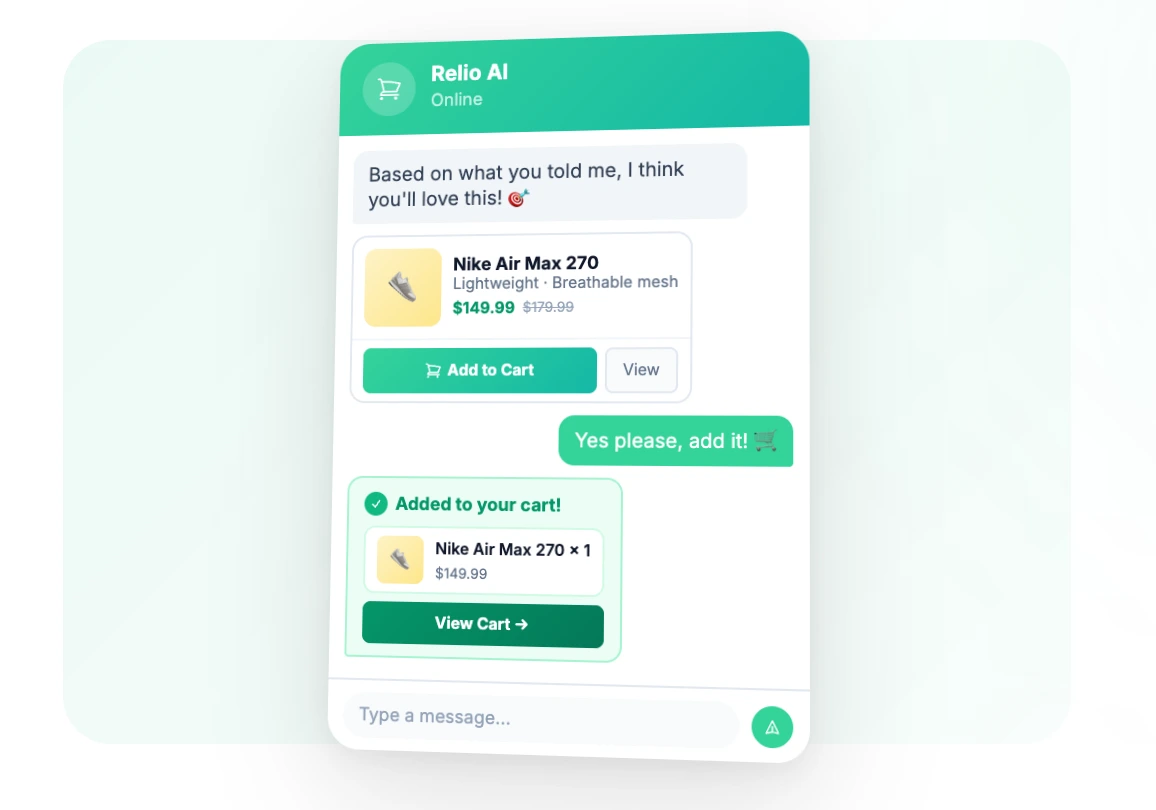
Let customers add products directly to their cart from the chat widget. Seamless in-chat purchasing for higher conversions.
- One-click add to cart
- In-chat purchasing flow
- Seamless checkout redirect
Today's consumers are savvier, valuing convenience and personalization more than ever. They use multiple devices throughout their shopping journey, expecting consistency and ease of use across platforms. Technology such as AI in e-commerce has enabled stores to offer tailored product recommendations and dynamic pricing, which can enhance customer retention and improve e-commerce sales.
Statistics show that cart abandonment rates remain a significant challenge for online retailers. According to industry data, the average cart abandonment rate in 2026 is around 68%, highlighting the ongoing struggle to convert interested visitors into paying customers. Factors like unexpected shipping costs, complicated checkout processes, and lack of trust in the payment security contribute to why customers abandon carts.
To combat this, retailers are focusing on cart abandonment solutions and sales conversion optimization strategies. AI-powered chat widgets like Relio, which recommend products and capture leads through natural conversation, play a crucial role. Features like "Real-Time Product Recommendations" and "Automated Lead Capture" help in addressing customer hesitations and guiding them towards completing their purchases. For more insights on how to optimize abandoned cart recovery without email, visit this article.
By leveraging AI technologies, e-commerce stores can better understand and meet customer expectations, ultimately reducing cart abandonment rates. For more insights on how AI can rescue abandoned carts automatically, visit our dedicated blog post.
Common Reasons Customers Leave Without Buying
In the fast-paced world of online shopping, understanding why customers leave without buying is crucial for e-commerce success. Several common issues can deter potential buyers and impact sales conversion optimization.
One of the primary reasons is unclear pricing. Customers expect transparency, and when prices are hidden or complicated, they lose trust. Lack of trust is another major factor. Shoppers need to feel secure when making online purchases. Provide clear contact information and visible security badges to reassure them.
Complicated checkout processes also drive customers away. Streamlining the checkout process optimization can significantly reduce bounce rates. Ensure your forms are short and easy to navigate. Slow website speed is another pain point. In 2026, online shoppers expect fast, seamless experiences. A slow site can cause frustration and lead to cart abandonment.
With the rise of mobile shopping, a poor mobile experience can also turn customers off. Ensure your site is mobile-responsive and easy to use on any device. Implementing e-commerce personalization can address many of these issues by tailoring the experience to individual preferences.
These challenges directly impact customer retention. If shoppers find your site difficult or untrustworthy, they're less likely to return. This hurts your bottom line and increases customer acquisition costs.
Relio is an AI-powered chat widget for e-commerce stores that recommends products and captures leads through natural conversation. It can help mitigate these issues. For instance, Relio's Real-Time Product Recommendations feature uses AI to suggest products that match the visitor's interests, enhancing personalization and increasing online sales. Additionally, the Simplified Lead Capture feature ensures that capturing visitor information is seamless, reducing friction in the checkout process. For more information on how AI can improve your conversions, explore this article.
By addressing these common issues, your store can thrive in the competitive landscape of online shopping trends 2026.
Solutions to Improve Customer Retention
In the competitive world of e-commerce, retaining customers is crucial for increasing online sales. One effective strategy is optimizing your website speed. A faster website enhances user experience, encouraging customers to complete their purchases. Ensure that your site is mobile-friendly since mobile shopping optimization is key to retaining customers who shop on-the-go.
Improving the checkout process is another critical step. Simplify the steps and provide multiple payment options to prevent cart abandonment. Shopping cart recovery techniques, such as sending reminder emails, can also help in this regard.
Integrating AI tools and ecommerce chatbots can further enhance customer retention. Relio is an AI-powered chat widget for e-commerce stores that recommends products and captures leads through natural conversation. By providing real-time assistance, an AI sales assistant like Relio can guide customers through their shopping journey, addressing their queries instantly.
Personalization plays a vital role in customer engagement. AI-driven solutions can analyze real-time analytics to offer personalized recommendations, making customers feel valued and understood. Relio's Personalized Product Recommendations feature uses AI to suggest products based on customer behavior, increasing the likelihood of a purchase.
Additionally, Relio's Automated Lead Capture feature engages visitors with tailored messages, capturing potential leads even if they leave without buying. This proactive engagement helps in nurturing relationships with customers, encouraging them to return.
For more insights on how AI chatbots can increase e-commerce conversions, explore our detailed guide: How AI Chatbots Increase E-commerce Conversions.
| Strategy | Impact on Customer Retention |
|---|---|
| Website Speed Optimization | Enhances user experience, reduces bounce rates |
| Checkout Process Optimization | Reduces cart abandonment, improves sales |
| AI Chatbots | Provides instant support, personalizes shopping experience |
| Personalized Product Recommendations | Increases engagement, boosts conversion rates |
By implementing these strategies, you can significantly improve customer retention and drive your e-commerce store's success.
How Relio Solves This
Relio is an AI-powered chat widget for e-commerce stores that recommends products and captures leads through natural conversation. One common reason customers leave without purchasing is a lack of personalization. Relio addresses this with its AI-driven personalization features, which tailor the shopping experience to each visitor. By understanding customer preferences through natural conversation, Relio offers product recommendations that resonate with individual shoppers, enhancing the user experience and reducing bounce rates.
Another key factor is understanding customer behavior in real-time. Relio's real-time analytics provide e-commerce stores with AI-driven insights into customer pain points. This allows merchants to identify issues like website speed problems or confusing navigation quickly. By addressing these concerns immediately, stores can improve customer experience and encourage conversions.
Seamless integration with existing e-commerce platforms is crucial for maintaining a smooth operation. Relio offers comprehensive e-commerce integration, ensuring that its chat widget works flawlessly with your current systems. This integration streamlines data flow, enhances features like mobile shopping optimization, and boosts customer engagement tools.
Consider how a visitor might interact with Relio:
With responses like these, Relio guides visitors towards their ideal purchase, increasing the likelihood of a sale. If you're considering a tested solution, check the current offer here.
To dive deeper into how AI can rescue abandoned carts and boost conversions, you might find our article on abandoned carts insightful. Relio's comprehensive suite of features can transform visitor interactions, making it an invaluable tool for any e-commerce store looking to enhance customer satisfaction and drive sales.
Old Way vs. Relio Way: A Comparative Analysis
Understanding why customers leave without buying is crucial for any e-commerce store looking to improve its sales. Traditional methods often fall short when it comes to efficiency and customer satisfaction. Let's explore the differences between the old way of handling e-commerce interactions and the modern, AI-powered approach offered by Relio.
| Aspect | Old Way | Relio Way |
|---|---|---|
| Customer Interaction | Static FAQ pages, impersonal | Personalized shopping experience through AI-driven conversations |
| Efficiency | Manual responses, delayed | Instant AI responses with deep e-commerce integration |
| Sales Conversion | Lower conversion rates | Maximizing conversion rates with tailored product recommendations |
| Customer Trust | Limited trust-building, generic | Improving customer trust online with personalized assistance |
Relio, an AI-powered chat widget for e-commerce stores that recommends products and captures leads through natural conversation, offers a seamless e-commerce solution that reduces friction and enhances customer satisfaction. The AI-driven insights provided by Relio allow for a better understanding of consumer behavior, enabling stores to adapt quickly and offer tailored solutions to visitors.
One of Relio's standout features is its 24/7 Automated Chat Support, which ensures that customers receive immediate assistance at any time, significantly improving the shopping experience. Additionally, Relio's Dynamic Product Recommendations drive conversions by suggesting items based on customer preferences, leading to a more personalized shopping experience.
According to a real-world example shared in our blog article, StyleHouse, an e-commerce fashion retailer, implemented Relio and saw a notable increase in customer engagement and sales conversions. The AI-powered chat widget allowed them to interact with customers more effectively, leading to a substantial boost in their revenue.
By integrating Relio, e-commerce stores not only enhance customer interactions but also secure a competitive edge in the market. Relio's approach to understanding consumer behavior and offering relevant solutions bridges the gap between traditional methods and modern demands, ultimately leading to a decrease in lost sales.
For more on how Relio can transform your e-commerce store, explore our features page to discover seamless solutions tailored to your business needs.
Implementing Relio: A Step-by-Step Guide
Relio is an AI-powered chat widget for e-commerce stores that recommends products and captures leads through natural conversation. When customers leave without buying, it could be due to friction in the buying process. Implementing Relio can help reduce this e-commerce friction by providing a seamless and engaging shopping experience. Here’s a practical guide to integrating Relio into your e-commerce store, setting up its features, and maximizing its potential for higher conversion rates and increased customer loyalty.
Start by visiting the Relio features page to understand its capabilities. Once familiar, follow these steps to integrate Relio:
- Installation: Access your store's backend and navigate to the app store or plugin section. Search for Relio and install it. Ensure compatibility with your platform by checking the list of supported integrations.
- Configuration: After installation, configure Relio by linking it to your product catalog. This step is crucial for the AI to recommend products accurately.
- Customization: Use the "Customizable Chat Interface" to match the chat widget's appearance with your store's theme. Adjust the tone and language settings to align with your brand voice.
- Activating Features: Enable key Relio features such as "Product Recommendation Engine" and "Lead Capture Form" to optimize product pages and capture potential leads who might abandon their carts.
Best practices for maximizing Relio's potential involve understanding consumer behavior and the impact of AI on sales. Analyze chat interactions to identify common questions or issues. Use this data to refine your FAQ section and improve product descriptions, making information readily available to consumers.
To further enhance performance, regularly update Relio's AI with new product launches and seasonal promotions. This keeps conversations relevant and engaging, increasing the likelihood of conversion. For an in-depth guide on setup, visit the complete guide to Relio setup.
By following these steps, you can ensure that Relio effectively reduces friction in the shopping journey, understands consumer behavior, and maximizes conversion rates. This investment in e-commerce SaaS technology pays off by enhancing customer experience and loyalty.
cta_headline
cta_text
Conclusion
Understanding why customers abandon their shopping carts is crucial for any e-commerce store aiming to improve sales. Factors such as complex checkout processes, lack of product information, and limited payment options often lead to this issue. By addressing these concerns, store owners can enhance the shopping experience and retain more customers. Implementing tools like Relio, an AI-powered chat widget for e-commerce stores that recommends products and captures leads through natural conversation, can make a significant difference. Features like "Conversational Product Recommendations" and "Automated Lead Capture" ensure customers receive the assistance they need right when they need it. To dive deeper into optimizing your store's performance, consult a specialist or explore Relio's features and integrations. Visit the features page to learn how Relio can transform your e-commerce strategy.
How does website design impact customer purchasing decisions?
Do customer reviews affect buying behavior?
How important is customer service in preventing cart abandonment?
What role does pricing strategy play in customer retention?
Frequently Asked Questions
Customers often leave without buying due to high prices, lack of product availability, or a poor shopping experience. Additionally, if they find the checkout process complicated or lengthy, they may abandon their carts.
A poorly designed website can deter customers from making a purchase. If the navigation is confusing or the site is slow to load, customers may become frustrated and leave without completing their transaction.
Yes, customer reviews play a significant role in purchasing decisions. Negative reviews can lead to distrust, prompting potential buyers to seek alternatives elsewhere before making a commitment.
Excellent customer service is crucial in reducing cart abandonment. If customers have questions or concerns and cannot easily access support, they may choose to leave the store rather than risk a negative experience.
Pricing strategy is vital for customer retention; if customers perceive prices as too high or not competitive, they are likely to abandon their shopping cart. Offering promotions or transparent pricing can help encourage purchases and reduce drop-off rates.